Students can use Class 7 Science Curiosity Extra Questions and Chapter 2 Exploring Substances Acidic Basic and Neutral Extra Question Answer to prepare effectively at home.
Class 7 Science Chapter 2 Exploring Substances Acidic Basic and Neutral Extra Questions
Class 7 Science Chapter 2 Extra Questions on Exploring Substances Acidic Basic and Neutral
Exploring Substances Acidic Basic and Neutral Class 7 Very Short Question Answer
Question 1.
What is indicator ?
Answer:
Substance shows change in colour when it comes in contact with acid or base.
Question 2.
What made Ashwin and Keerthi excited and curious at science fair?
Answer:
Their white sheets showed colourful words after sprayed with liquid. This made them very excited and curious.
Question 3.
What are uses of haldi ?
Answer:
Haldi is used in kitchen and as an indicator.
Question 4.
How is China rose prepared ?
Answer:
By keeping China rose petals in warm water.
Question 5.
Name two indicators used in labs.
Answer:
Haldi, litmus paper.
Question 6.
What is a salt ?
Answer:
A compound formed by neutralisation of an acid and a base.

Question 7.
What happens when bee stings ?
Answer:
Bee stings to release formic acid in skin.
Question 8.
What does factory waste contain?
Answer:
It contains acids.
Question 9.
What are lichens ?
Answer:
An associations of an alga and a fungus.
Question 10.
Name acid found in lemon.
Answer:
Citric acid.
Question 11.
Name two natural indicators.
Answer:
Litmus and turmeric.
Question 12.
Name two synthetic indicators which are used to test for acids and bases.
Answer:
Methyl orange and phenolphthalein.
Question 13.
What is the colour of litmus solution when it is neither acidic nor basic?
Answer:
Purple.
Question 14.
Name the acid present in bee-sting that causes pain.
Answer:
Methanoic acid.
Question 15.
Name the acid present in sour milk or curd.
Answer:
Lactic acid.
Question 16.
Name the acid present in oranges or lemon.
Answer:
Citric acid.
Question 17.
What is meant by a neutralisation reaction?
Answer:
The reaction between an acid and a base to form salt and water is called neutralisation.
Question 18.
What colour do the following indicators turn when added to an acid ?
(a) Litmus solution
(b) China Rose indicator.
Answer:
(a) Red,
(b) Magenta (Deep pink).
Question 19.
What colour do the following indicators turn when added to a base ?
(a) Litmus solution
(b) China Rose indicator.
Answer:
(a) Blue
(b) Green.
Question 20.
(a) Name one indicator which turns red on adding an acid.
(b) Name one indicator which turns red on adding a base.
Answer:
(a) Litmus
(b) Turmeric paper.
Question 21.
What can you say about the nature of a solution which turns blue litmus paper red ?
Answer:
Acidic.
Question 22.
Why does a turmeric stain on white shirt is turned to red when it is washed with soap ?
Ans.
It is because the soap solution is basic.
Question 23.
Name a substance which is used to neutralise the effect of excessive acid in stomach.
Answer:
Milk of magnesia which contains magnesium hydroxide (base).
Question 24.
Name the salt formed when hydrochloric acid neutralises sodium hydroxide solution.
Answer:
Sodium chloride.
Question 25.
What is the colour of litmus in a solution of ammonium hydroxide ?
Answer:
Red litmus turns black in solution of ammonium hydroxide.
Exploring Substances Acidic Basic and Neutral Class 7 Short Question Answer
Question 1.
Give examples of any two acids.
Answer:
Formic acid, Lactic acid.
Question 2.
What do you know about Haldi ?
Answer:
It is called golden spice used in kitchen, in laboratory it is use as an indicator.
Question 3.
Write neutralisation reaction.
Answer:
Acid + Base → Salt + H2 O + Heat ↑
Question 4.
Give an example of neutralisation in daily life.
Answer:
Sting bite causes pain in arm. The formic acid is released into skin. Applying baking soda to skin gives relief.
Question 5.
Fish die in lakes when factory waste is released. Why?
Answer:
The factory waste contain acids that kill fishes. To avoid it, basic substances are added in lake.
Question 6.
Name two common edible substances and name acids found in them.
Answer:
(i) Lemon – Citric Acid.
(ii) Amla – Ascorbic Acid.
Question 7.
What are acids and bases?
Answer:
Acids sour taste. Bases taste bitter and generally slippery to touch.
Question 8.
What is lime water?
Answer:
It is solution of calcium hydroxide. Mix lime in water and leave for one hour. Lime water is ready.
Question 9.
From where litmus is obtained?
Answer:
Litmus is a natural substance obtained from lichens available as paper strips in two colours- Red and Blue.
Question 10.
What does a basic substance feel like when it touched?
Answer:
Basic substance usually feel slippery or soapy when touched. e.g., baking soda solution.
Question 11.
Explain why farmers add slaked lime to acidic soils.
Answer:
The bases such as slaked lime neutralise the excess acid present in the soil and reduce its acidic nature.
Question 12.
A milkman adds a very small amount of baking soda to fresh milk. Why does this milk take a longer time to set as curd ?
Answer:
Fresh milk is made slightly alkaline by adding a little of baking soda. The slightly alkaline milk makes a longer time to set into curd because the lactic acid being formed during curdling has to first neutralise the alkali present in it.
Question 13.
The soil in a field is highly acidic. Name two materials which can be added to this soil to reduce its acidity. Give reason for your choice.
Answer:
The two materials which can be added to a highly soil to reduce its acidity are quick lime (calcium oxide) and slaked lime. Quick lime and slaked lime are bases which will neutralise the excess acid present in the soil and reduce its acidity.
Question 14.
If someone is suffering from the problem of acidity after overeating, which of the following would you suggest as remedy ? Lemon juice, Vinegar, Baking soda solution. Give reason for your choice.
Answer:
Baking soda solution. Being basic, it neutralises excess acid in the stomach.
Question 15.
Write any three properties of an acid.
Answer:
(i) Acids have a sour taste.
(ii) Acids turn blue litmus red.
(iii) Acids react with bases (or alkalis) to form salt and water.
Question 16.
Write any three properties of a base.
Answer:
(i) Bases have bitter taste.
(ii) Bases feel soapy to touch.
(iii) Bases turn red litmus to blue.
Question 17.
Write the names of most common substances and their acids they have.
Answer:
(a) Amla-Ascorbic Acid + Citric Acid
(b) Lemon – Citric Acid
(c) Imli – Tartaric Acid
(d) Vinegar – Acetic Acid
Question 18.
Distinguish between Acids and Bases.
Answer:
Difference between Acids and Bases:
| Acids | Bases |
| 1. They taste sour. | 1. They taste bitter, soapy in touch. |
| 2. e.g., Acetic acid, formic acid. | 2. e.g., baking soda slaked lime Ca(OH)2 |
Question 19.
What is Indicator ? Mention its two groups.
Answer:
Indicator is used to get to know the chemical nature of a substance. They are of two types (a) natural, (b) synthetic. Litmus solution is natural indicator. But methyl orange is svnthetic indicator.
Question 20.
Comment on Haldi as indicator.
Answer:
Haldi is called turmeric. It is used in kitchen. It is used to test nature of acidic and basic substances. Haldi is yellow in acidic and neutral media. It Reddish brown in basic medium.
Question 21.
Write three sentences about China rose.
Answer:
(a) It is used as an indicator.
(b) China rose is prepared by keeping China rose petals in warm water for sometime.
(c) China rose extract becomes dark pink if added to acid medium. It becomes green if added to a basic substance.
Question 22.
What is a salt ? How do you prepare it?
Answer:
Salt is a compound. It is prepared by neutralisation of an acid and a base. The reaction is – Acid + Base → Salt + Water + Heat is evolved ↑.
Question 23.
Gaurav lives near a lake in industrial area. He told his friend Mahesh that fish in lake was declining. Give one reason and remedy to solve the problem.
Answer:
Lake contain acids released by factory waste that kills fish population. To avoid it, add basic substance to lake.
Question 24.
Litmus is an acid base indicator. Explain in short.
Answer:
Litmus shows different colours in acidic and basic solutions. The substances which turn blue litmus to red are acidic. White substances that turn red litmus to blue are basic.
Question 25.
Write two modern day problems.
Answer:
(a) Ant bite.
(b) Acidic/Basic nature of the soil. Ant strings to release formic acid in skin.
(c) In too acidic soils plants do not grow properly.
Question 26.
What happens during a honey-bee sting? What is its remedy ?
Answer:
When a honey-bee stings a person, it injects an acidic liquid into the skin which causes immense pain and irritation. The remedy is to rub a mild base like baking soda on the stung area. Being a base, baking soda neutralises the acidic liquid injected by the bee-sting and gives relief.
Question 27.
What is a neutralisation reaction ? Elaborate with two examples.
Answer:
The reaction between an acid and a base to form salt and water is called a neutralisation reaction. That is:
Acid + Base → Salt + Water:
The examples of neutralisation reactions are as follows:
(i) Sodium hydroxide reacts with sulphuric acid to form sodium sulphate and water.
(ii) Magnesium hydroxide reacts with hydrochloric acid to form magnesium chloride and water.
Question 28.
While diluting an acid, why is it recommended that the acid should be added to water and not water to the acid?
Answer:
Dilution of concentrated acid with water is a highly exothermic process. The concentrated acid must always be added slowly to water with constant stirring. If water is added to a concentrated acid, then the heat generated is so larger that it many cause the mixture to splash out and cause burns.
Question 29.
Tooth enamel is one of the hardest substances in our body. How does it undergo damage due to eating chocolates and sweets ? What should we do to prevent it ?
Answer:
Bacteria present in the mouth produce acids by degradation of sugar (from chocolates and sweets) and food particles remaining in the mouth after eating. Due to this, the enamel gets corroded.
Prevention of tooth decay:
(i) Cleaning mouth after eating food.
(ii) Using tooth particles which are generally basic as they can neutralise the excess acid and prevent tooth decay.
Question 30.
A person is suffering from indigestion due to the intake of hot spicy food. What remedy will you prescribe to the patient? Give the name of a chemical that can give relief to him.
Answer:
The patient should take antacids. Antacid reacts with excess acid in the stomach and neutralize it. This gives relief to the person concerned. The two common antacids are: Magnesium hydroxide (Milk of magnesia) and sodium hydrogen carbonate (Baking soda).
Exploring Substances Acidic Basic and Neutral Class 7 Long Question Answer
Question 1.
Explain neutrialisation reaction. Give example. Write its compliation in daily life.
(Imp.)
Answer:
If solution of acid and solution of a base are mixed, the reaction is known as neutralisation reaction. e.g., Acid + Base → Salt + Water + Heat.
HCl + Na(OH)2 → NaCl + H2 O + Heat ↑
Ant bites → Injects formic acid into skin → Cause pain, skin becomes red → Neutralised by rubbing moist baking soda (base).
Question 2.
Write about lime water neutralisation by acid with an example.
Answer:
Add one drop of litmus solution to lemon juice → colour of solution change, to red → add lime water to it → The colour changes from Red to the blue → lime water neutralised the effect of acid (lemon juice).
Question 3.
Write explanatory notes on:
(a) Litmus (b) Lichens
Answer:
(a) Litmus: This is a natural substance. It is obtained from lichens that grow on rocks. It is found in solution form as well as in form of paper strips called litmus papers. Red and blue colours of litmus are available. Litmus is an acid base indicator.
(b) Lichens: They grow on trees in the are as where there is more abundant rainfall. Lichens refer to an association (mutualistic) of a living organisms – an alga and a fungus. The litmus is obtained from lichens.
Question 4.
Turmeric is used as an indicator. What are fascinating facts about turmeric ?
Answer:
The turmeric paper is used to test acidic and basic substances. Turmeric does not distinguish between acidic as well as neutral substances. Turmeric is called golden spice or haldi. It is grown in our country. It belongs to ginger family in kitchens, it is used daily as spice. It is used as medicine to cure many disorders.
Question 5.
How do you prepare red rose extract ? Can it is used as an indicator, find out?
Answer:
Select some fallen red rose petals from four neighbour wash petals of red rose by water. Crush petals in a mortal by pestle. Now put them in a glass/container. Immerse them in hot water. Filter the coloured water of petalo for use as acid base indicator. You will find that red rose extract will give red colour is an acidic solution but green in a basic one.
Question 6.
How will you treat the following:
(i) high acidity in the stomach, (ii) pain caused by a bee sting, (iii) too much acidic soil ?
Answer:
(i) High acidity in the stomach: We generally take antacid tablet or gel. The antacid tablets or gels contain aluminium hydroxide or magnesium hydroxide. Aluminium hydroxide and magnesium hydroxide are weekly basic in nature.
Therefore antacids neutralise the excess acid present in the stomach and provide some relief.
(ii) Pain caused by a bee sting: When an ant or bee stings, formic acid gets injected into the skin. This acid causes irritation and swelling.
To get relief from the irritation and swelling, baking soda paste is rubbed at the sting site. Baking soda is basic and therefore neutralises the formic acid left behind after the sting.
(iii) Treatment of soil: If the soil is too acidic, it can be corrected by adding quicklime (calcium oxide) or slaked lime (calcium hydroxide). Both quick time and slaked lime are basic and thus neutralise the excess acid of the soil.
Exploring Substances Acidic Basic and Neutral Class 7 Case Based Questions
1. Read the following passage carefully and answer the questions that follow:
Some plants grow well in neutral soils, when soil is too acidic or alkaline, the plants do not grow well. When soil is too acidic quicklime, a base or slaked lime is added for proper plant growth. Manures/composted leaves are added to basic soil. The organic matter neutralise the soil at all as it releases acids.
(i) The plants do not grow well in:
(a) Neutral soils
(b) Basic soils
(c) Acidic soils
(d) None of these
Answer:
(a) Neutral soils
(ii) Too acidic or too alkalime soil require for proper plant growth:
(a) quick lime
(b) slaked lime
(c) chalk
(d) All of these
Answer:
(d) All of these
(iii) Organic matter neutralise basic nature of the soil as that release:
(a) acids
(b) bases
(c) both (a) and (b)
(d) None of these
Answer:
(a) acids
2. Read the following passage carefully and answer the questions that follow:
During a science fair, Ashwin and Keerthi received white sheets of paper at the entrance. A volunteer sprayed a liquid on them, and the words “Welcome to the Wonderful World of Science” appeared. Fascinated, the children visited a stall that demonstrated the use of litmus paper to test the acidic or basic nature of substances. They tested lemon juice, soap solution, salt water, and baking soda solution using both blue and red litmus papers and grouped them based on the changes observed.
(i) Which of the following substances will turn red litmus paper blue?
(a) Vinegar
(b) Soap solution
(c) Sugar solution
(d) Tamarind water
Answer:
(b) Soap solution
(ii) If a substance does not change the colour of either blue or red litmus paper, it is most likely:
(a) Acidic
(b) Basic
(c) Neutral
(d) Synthetic
Answer:
(c) Neutral
(iii) In the litmus paper activity, which group would baking soda solution fall under?
(a) Group A – turns blue litmus red
(b) Group B – turns red litmus blue
(c) Group C – no change
(d) None of these
Answer:
(b) Group B – turns red litmus blue
(iv) What change will occur when blue litmus paper is dipped in lemon juice?
Answer:
It turns red.
Explanation: Lemon juice is acidic and acids turn blue litmus paper red.
3. Read the following passage carefully and answer the questions that follow:
In another experiment, students were introduced to natural indicators like red rose extract and turmeric paste. They noticed that red rose extract turned red in acidic solutions and green in basic ones. Turmeric paper turned reddish-brown in bases but showed no change in acids or neutral substances. They also learned about hydrangea flowers that change colour depending on soil nature, and discussed the use of such indicators in daily life.
(i) What colour change is expected when red rose extract is added to lemon juice?
(a) Green
(b) Red
(c) Purple
(d) No change
Answer:
(b) Red
(ii) Which natural indicator turns reddish-brown when mixed with a basic solution like soap water?
(a) Red rose extract
(b) Turmeric paper
(c) Litmus solution
(d) Beetroot juice
Answer:
(b) Turmeric paper
(iii) A hydrangea plant grown in acidic soil shows what colour of flowers?
(a) Red
(b) Pink
(c) Blue
(d) Yellow
Answer:
(c) Blue
(iv) What property makes red rose extract and turmeric useful as indicators?
(a) They are colourful
(b) They are natural and change colour with pH
(c) They dissolve easily in water
(d) They are fragrant
Answer:
(b) They are natural and change colour with pH
Exploring Substances Acidic Basic and Neutral Class 7 Picture Based Questions
1. Lemons sour taste. They are source of citric acid. The acids have sour taste. Lemon juice is natural occuring acid found in lemons.

See the picture and answer the questions:
(a) Give source of citric acid.
(b) Why do they have sour taste?
Answer:
(a) Lemons
(b) Because lemons contain citric acid.
2. The lichens are association of an algae and a fungus growing on rocks and trees in areas where there is sufficient rainfall.

Litmus is obtained from the lichens. It is a natural indicator available in solution and litmus paper in blue and red colours. It is purple in distilled water.
See the pictures and answer the question:
(a) Name the figure.
(b) What is litmus?
(c) Which type of indicator it is?
Answer:
(a) Lichen.
(b) Litmus is natural indicator obtained from lichens.
(c) It is acid base indicator.
3. Observe the picture and answer the following questions:
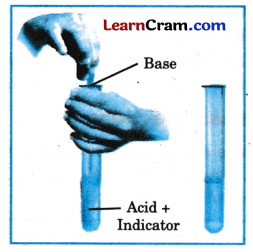
Question 1.
What does the given set up show?
(a) Process of neutralisation
(b) Process of cooling down
(c) Process of making solution
(d) None of these
Answer:
(a) Process of neutralisation
Question 2.
Which substance is used in the above setup?
(a) Citric acid
(b) Sulphuric acid
(c) Phenolphthalein
(d) None of these
Answer:
(c) Phenolphthalein
Question 3.
What do you observe from the given setup?
Answer:
When the solution is basic, phenolphthalein gives a pink colour. On the other hand, when the solution is acidic, it remains colourless.
Exploring Substances Acidic Basic and Neutral Extra Questions for Practice
Multiple Choice Questions (MCQs):
Question 1.
Lemon juice possesses:
(a) acetic acid
(b) lactic acid
(c) citric acid
(d) tartaric acid
Question 2.
Which is correct answer?
(a) Vinegar changes colour of blue litmus paper to red.
(b) Lime water changes blue litmus paper to red.
(c) Blue litmus paper does not change colour of sugar solution.
(d) All are correct
Question 3.
Select the correct one:
(a) Tamarind water, lemon juice, amla juice, vinegar turn blue litmus paper to red.
(b) Baking soda solution, soap solution, washing powder solution and lime water change red litmus paper to blue.
(c) Tap water, salt solution and sugar solution do not change colour of red or blue litmus paper.
(d) All of the above
Question 4.
Hydrangea plant:
(a) Grows in cooler regions of Himalaya
(b) Also grows in North-Eastern states
(c) Produces flowers of varied colours
(d) All of the above
Question 5.
An acid plus a base neutralise each other when mixed:
(a) They form water plus salt
(b) Heat is evolved in this reaction
(c) The reaction is called neutralisation
(d) All of the above
Very Short Answer Type Questions:
Question 1.
Name an indicator.
Question 2.
What is lime water?
Question 3.
Give an example of acid.
Question 4.
What does extract of lichens indicate?
Question 5.
How is factory waste neutralised?
Short Answer Type Questions:
Question 1.
How does execessive use of chemical substances help farmers?
Question 2.
What is stinging effect of autbite?
Question 3.
Distinguish between acid basic and olfactory indicators.
Question 4.
Turmeric is an indicator which is natural. Why?
Question 5.
Can red rose flowers found in your neighbour be used as an indicator?
Question 6.
Name any three natural indicators.
Question 7.
Name three most common acids found in edible substances.
Question 8.
Write names of most common acids found in curd, lemon, tamarind and vinegar.
Question 9.
Write short notes on:
(a) Hydrangea plant
(b) Lichens
(c) In indicator nature of soil
(d) Acidic or basic
Long Answer Type Questions:
Question 1.
Can extract of purple cabbage and red hibiscus be used as indicator? How? Explain briefly with example of acidic, basic, neutral substances.
Question 2.
Plants do not grow well in basic and neutral soils. Why ? Give one reason.
Question 3.
Factory waste if released in lakes in industrial are as decline fish population. Why? Give one remedy to it.
Question 4.
Name the scientist called as “Father of Modern Indian Chemistry”. Write his contribution to modern world.